
It is Important!
Wind Loads
When building something like your home are attaching a structure to it, they need to built strong, secure and wind resistant. Wind load calculations are important to ensure that the structure can withstand the kind of winds common to your area. Wind load calculations can be difficult to figure out because the wind is unpredictable, however the IBC standards can give you a good idea of what a building can withstand. Wind loading analysis is an essential part of the building process.
Snow Loads
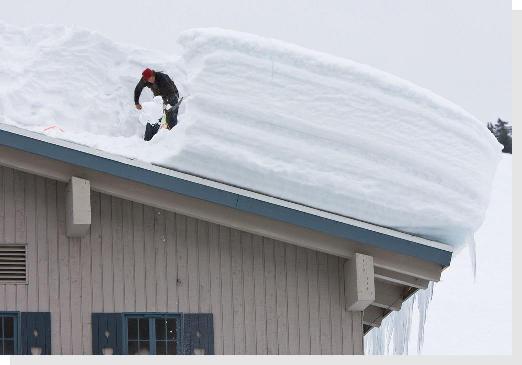
Roof snow loads are influenced by elevation of the area you live in, wind, general weather patterns and moisture laden air, roof configuration and slope. We always ask you to call your local building department to get the wind and snow load requirements for your area because overestimation of load requirements unnecessarily increases the cost of construction and underestimation of load requirements creates the potential for unit failure and safety issues.
Roof snow and wind loads are based on the historical records for a given location, however the local building authority should always be consulted to determine the correct roof snow and wind load to use for a given site and application.
The weight of snow varies greatly. Light fluffy snow may only weigh about seven pounds per cubic foot. More average snow may weigh 15 pounds per cubic foot and drifted compacted snow may weigh 20 pounds or more. The following calculation is based on a 25% moisture density which is conservative. As a rule, saturated snow weighs about 20 lbs. per cubic foot. The moisture content of snow can range from 1% to 33%, which relates to weights of 1 pound to over 30 pounds per cubic foot.
Sample calculation: There are 7.48 gallons per cubic foot of water- that’s about 62.4 pounds.
- For Wet Snow – Let’s say wet snow would be equivalent to 1″ of rain or 5″ of snow, you would get a resulting 62.4/5 = 12.5 lbs./cu.ft.
- For Light, Fluffy Snow – Let’s say fluffy snow would be equivalent to 2.5″ of water and 12″ snow, you would get 62.4/12= 5.2 lbs./cu.ft.
Specifications
Note: 3″ Roof thickness simply references the thickness of the panel
How to read the table: For example… a 3″ thick roof panel will span 12′ away from the wall under a 25 lb. load requirement
| 20 psf | 25 psf | 30 psf | 35 psf | 40 psf | 50 psf | |
|---|---|---|---|---|---|---|
|
3″ Thick | .024″ Skin |
12’7″ |
11’7″ |
10’10” |
10’1″ |
9’6″ |
8’7″
|
|
4″ Thick | .024″ Skin |
15’1″ |
13’8″ |
12’7″ |
11’8″ |
10’11” |
9’9″ |
|
6″ Thick | .024″ Skin |
18’3″ |
16’5″ |
15′ |
14′ |
13’1″ |
11’9″ |
Note: .023 ga. = .023″ thick / This simply references the thickness of the pan
How to read the table: For example in the table below…
8’6″ is how far you can go ‘away from the wall’ before the .023″ thick pan needs to be supported under a 20lb. load requirement
| Live Load | Wind Speed | .023 ga. | .030 ga. |
|---|---|---|---|
|
20 |
115 |
8’6″ |
10’6″ |
|
30 |
115 |
7’6″ |
9’2″ |
|
40 |
115 |
5’8″ |
6’11” |
| Live Load | Wind Speed | .019 ga. | .025 ga. | .032 ga. |
|---|---|---|---|---|
|
Live Load |
Wind Speed |
.019 ga. |
.025 ga. |
.032 ga. |
|
20 |
115 |
7’5″ |
10’1″ |
11’1″ |
|
30 |
115 |
6’6″ |
8’10” |
9’8′” |
|
40 |
115 |
5’6″ |
7’6′” |
8’9″ |
Relevant Links / Information...
We have been doing this for over 20 years...
Our insulated laminated roof panels snap together tightly, forming a strong, structurally sound roof as well as a weatherproof barrier protecting your patio or vehicle from the elements.